-
 Visit our shop
-
English
Visit our shop
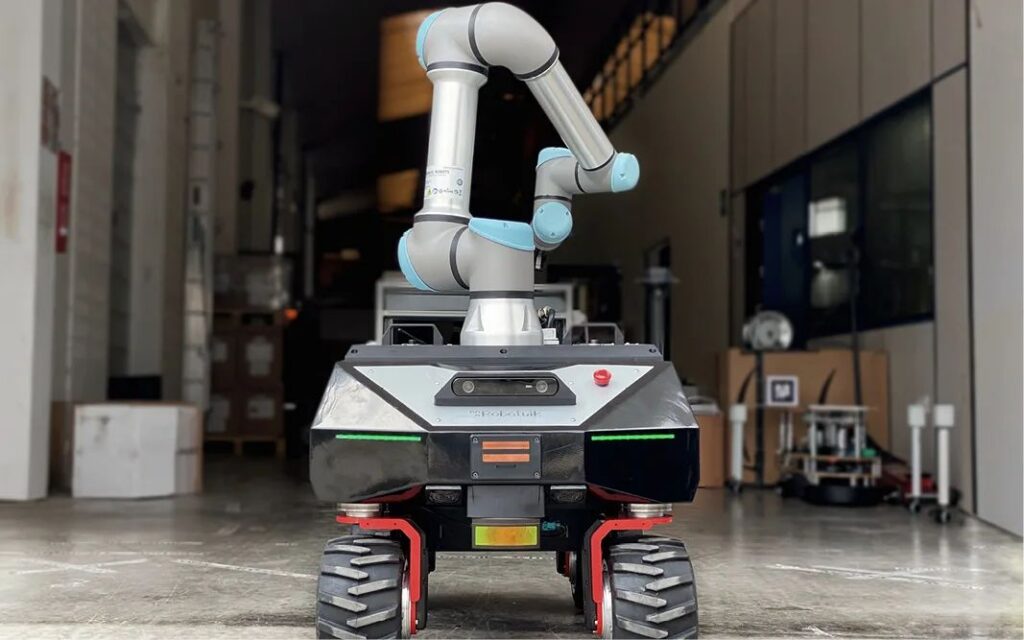
Developing a robot for an outdoor environment involves very different constraints from those encountered on a flat, controlled surface. The terrain changes, travel distances increase, localisation requirements evolve and sensors must continue to provide usable data in less predictable conditions.
For applied research teams and R&D departments, the choice of mobile base is therefore crucial. It must be able to operate outdoors while remaining open enough to integrate new sensors, navigation algorithms, perception systems or, depending on the project, manipulation capabilities.
This is precisely where the RB-VOGUI by Robotnik is positioned: an omnidirectional mobile robot designed primarily for outdoor R&D projects and the development of applications in sectors such as agriculture and industry. Its architecture is based on ROS 2, and its configuration can evolve throughout the project.
Developed in Spain by Robotnik, RB-VOGUI is an excellent option for teams looking to work with a mobile robotics platform designed and developed in Europe.
The RB-VOGUI is an autonomous mobile robot primarily intended for projects requiring the testing of navigation, perception or transport functions in outdoor environments. Its omnidirectional kinematics, payload capacity of up to 150 kg and ROS 2 architecture make it a particularly interesting development platform when a project needs to move beyond the laboratory environment.
Its modular design allows various components to be added, including GPS, 3D LiDAR, dedicated computing for vision and AI, and 3D localisation and navigation packages. In its RB-VOGUI+ version, the platform can also integrate a Universal Robots robotic arm for developing mobile manipulation applications.
Until 30 September 2026
15%
A mobile platform may work perfectly in a laboratory yet encounter difficulties when faced with real-world terrain.
Outdoors, the robot must cope with uneven surfaces, changes in gradient, longer distances, obstacles and variable environmental conditions. These constraints directly affect locomotion, localisation and the quality of the data used by the algorithms.
The RB-VOGUI was specifically developed to operate both indoors and outdoors. Its all-terrain base enables it to travel over uneven surfaces while maintaining excellent manoeuvrability, particularly for lateral movements and precise repositioning.
This feature is particularly useful when a project requires both mobility over uneven terrain and precise movement around an area of interest, a piece of equipment or a plot of land.
The robot can reach 2.5 m/s (9 km/h), operate for up to 6 hours and carry a payload of up to 150 kg. RB-VOGUI also features IP53 protection against dust and water spray and can operate on slopes of up to 47%.
In an R&D project, the configuration used during the initial tests is rarely the same as the one used several months later.
A team may begin by working on autonomous navigation before adding a new localisation method, a 3D LiDAR, perception algorithms or onboard computing for artificial intelligence.
This is where the modularity of RB-VOGUI becomes particularly valuable.
The robot includes an Intel Core i7 computer, an IMU, an RGB-D camera and two safety-dedicated 2D LiDAR sensors, providing 360° coverage around the robot.
It can then be equipped with various options such as GPS, RoboSense Airy or Helios 16P 3D LiDAR sensors, 3D localisation and navigation packages, or a camera and GPU package for vision and AI applications. Its architecture is based on ROS 2.
This open architecture allows a team to retain the same mobile base while gradually upgrading the hardware and software components of its demonstrator.
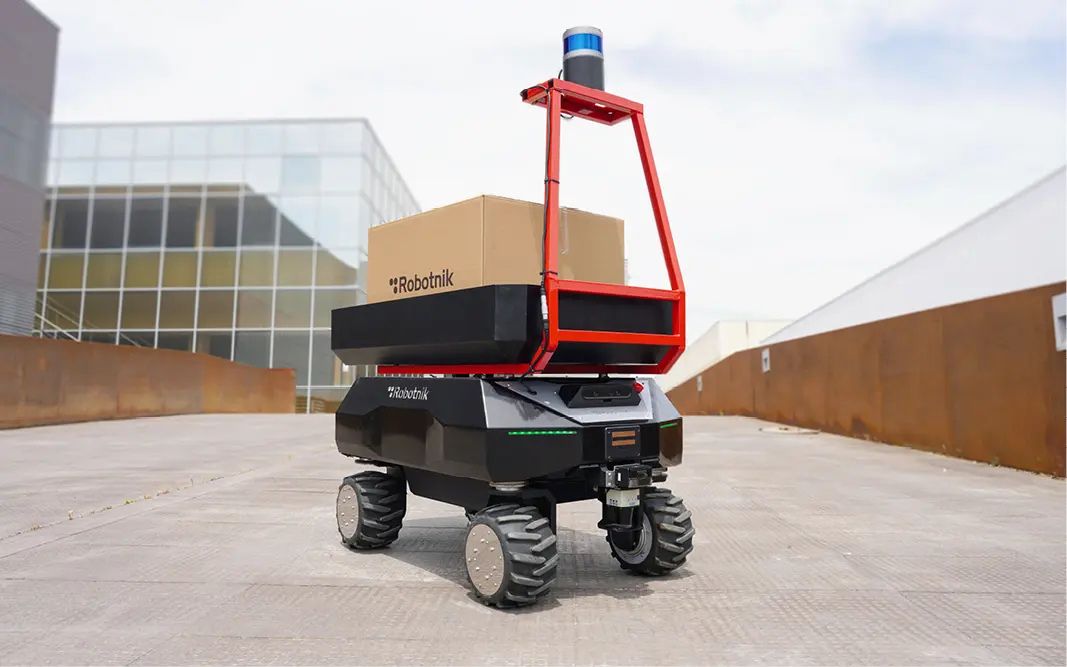
For a laboratory or research centre, an outdoor platform becomes particularly relevant when the objective is to test developments under conditions that more closely reflect their future use.
RB-VOGUI can, for example, be used to work on:
The aim is to have a robot that serves as a platform for building and validating an application, rather than an immediately operational turnkey solution.
This is an important distinction for applied research: the platform must allow teams to test, modify, measure and start again without locking them into a predefined scenario.
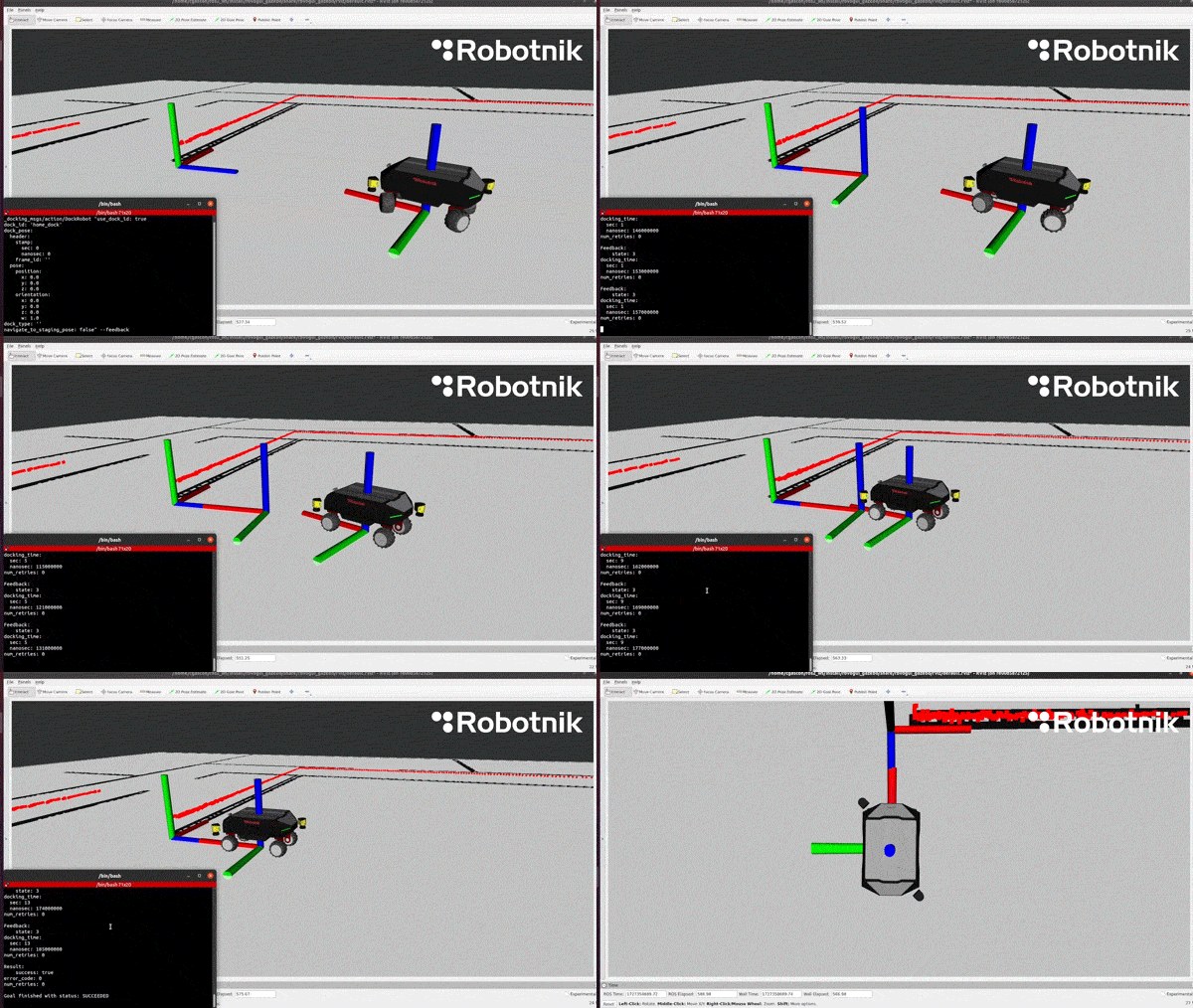
Agricultural environments combine several challenges specific to outdoor robotics: travelling over uneven terrain, covering large areas, perceiving the environment and carrying specialised equipment.
Robotnik specifically positions the RB-VOGUI for this sector. The platform can serve as a basis for crop monitoring, environmental data collection and outdoor autonomous navigation projects.
The robot’s modular design also allows the project to evolve. An initial phase may focus on mobility and data collection, before gradually integrating more advanced perception or manipulation capabilities.
With the RB-VOGUI+, Robotnik cites applications such as crop inspection and monitoring, fertiliser or pesticide application, and other tasks requiring physical interaction with the environment.
For agronomic research and agricultural robotics, the same platform can therefore support several development stages, from navigation through to intervention.
The requirement does not necessarily involve operating a robot in the middle of a field.
In some industrial projects, the constraints are instead associated with large outdoor spaces, traffic lanes, technical areas or terrain that lacks the regularity of a workshop floor.
An outdoor mobile platform can then be used to develop applications involving inspection, autonomous transport, data collection or the monitoring of areas of interest.
The payload capacity of the RB-VOGUI is also important in this context. It can carry up to 150 kg, leaving sufficient capacity for equipment, sensors or application-specific hardware.
The RB-VOGUI is therefore not always intended to replace a conventional industrial AMR. It is particularly relevant when a project combines outdoor mobility, uneven terrain, instrumentation and specific software development.
Some projects go beyond observation and transport.
With the RB-VOGUI+, the mobile base can be combined with a Universal Robots e-Series robotic arm to add manipulation capabilities. Robotnik offers several configurations with handling payloads of up to 12.5 kg, depending on the arm installed. In this configuration, the platform retains a payload capacity of up to 125 kg.
This combination opens up more complex research topics, including navigation-manipulation coordination, approaching an object, positioning the robot before grasping, handling tools and interacting with equipment in outdoor environments.
For laboratories working on mobile manipulators, the platform makes it possible to study these challenges outside the laboratory and test algorithms under real-world terrain constraints.
FURTHER READING
The RB-VOGUI is developed by Robotnik, a Spanish manufacturer specialising in autonomous mobile robots and mobile manipulators.
Its European origin may be an additional consideration for laboratories, technical centres and R&D teams looking to work with a platform designed within the European robotics ecosystem.
RB-VOGUI’s primary value remains technical: a ROS 2 architecture, a modular design and the ability to integrate various sensors, perception or navigation components, as well as a robotic arm depending on the configuration. This open architecture makes it possible to gradually adapt the platform to the project’s requirements and to experiments conducted in the field.
The RB-VOGUI is particularly relevant when a team is looking for an outdoor development platform rather than a robot dedicated to a single task.
It is especially useful when the project combines several of the following requirements: uneven terrain, payload capacity, ROS 2 and autonomous navigation, sensor integration, advanced perception or future development towards manipulation.
For a strictly indoor or highly compact project requiring only a simple mobile base, other platforms may be more suitable.
The choice therefore depends less on a list of features than on the project’s development path: where will the robot operate, which components will need to be developed and how far will the platform need to evolve?
This is precisely why RB-VOGUI is relevant for applied research, agriculture and certain industrial applications: it provides a sufficiently well-equipped platform to get started quickly while leaving room to develop, integrate and test the technologies specific to the project.
Generation Robots can help you select the right RB-VOGUI or RB-VOGUI+ configuration, sensors and equipment for your application and testing environment.
Until 30 September 2026, receive a 15% discount on RB-VOGUI and RB-VOGUI+ configurations.

Vanessa Mazzari
Responsable Marketing chez Génération Robots