-
 Visit our shop
-
English
Visit our shop
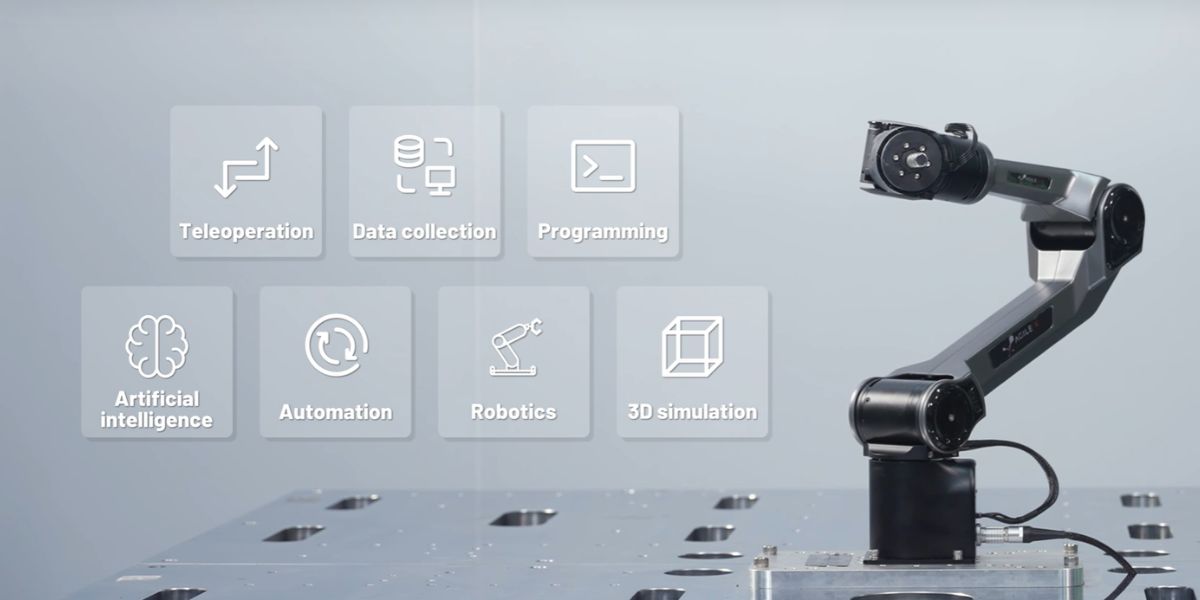
A robotic manipulation project can begin with a relatively simple task: grasping an object and moving it.
Yet the same platform can later be used to explore motion planning, perception, robot learning and Embodied AI.
Your choice of hardware should therefore address more than the first experiment you have in mind. For a university, laboratory or R&D team, the aim is to build a manipulation platform that can evolve with the project.
The PiPER robotic arm from AgileX Robotics, combined with its gripper, illustrates this progression: start with the fundamentals of manipulation using ROS 2 and MoveIt 2, then add software, perception and learning components.
The ROS 2 documentation maintained by AgileX Robotics includes interfaces for the arm and gripper (the agx_arm_ctrl package), as well as a MoveIt 2 configuration (the agx_arm_moveit package).
15% off PiPER by AgileX: 15% off the robotic arm and gripper
To manipulate an object, a robotic arm needs an appropriate tool for the task: a gripper to grasp and release objects, a suction cup to move flat, smooth objects, or another tool suited to the application.
A camera can then be added to locate objects, while a simulation environment can support the development of learning approaches. ROS 2 and MoveIt 2 provide the framework for control and motion planning.
Choosing an arm and gripper at the outset does not restrict the project to basic applications: the same platform can progress from pick-and-place to much more advanced robotic manipulation research.
| Component | Role in the project |
|---|---|
|
Robotic arm |
Position the gripper or end effector in space |
|
Gripper |
Grasp, hold and release objects |
|
ROS 2 |
Integrate the software components and enable communication between them |
|
MoveIt 2 |
Plan movements and manipulation tasks |
|
Camera |
Detect or locate objects, depending on the application |
|
Simulation |
Test or train certain approaches before validating them on the physical robot |
The robotic arm forms the mechanical foundation of the system. Its joints position a tool in space. To grasp and move an object, you then need to select a tool suited to the task, such as a gripper or suction cup.
A gripper, for example, can grasp objects of different shapes and sizes, hold them during movement and then release them. The arm and gripper perform distinct functions that must be coordinated.
This distinction is reflected in PiPER’s software environment. AgileX Robotics’ official MoveIt 2 configuration defines separate planning groups for the arm and gripper, including open and closed states for the latter.
It currently supports the PiPER Standard, PiPER H, PiPER L and PiPER X with the official PiPER gripper.
The platform can then evolve to meet the project’s needs. A camera can be added to detect or locate objects, while simulation makes it possible to test or train certain approaches before deploying them on the physical robot. This can save time and resources and reduce the risk of damaging the robot, for example through a poorly planned trajectory.
Grasping an object in one location and placing it in another may seem like a basic task. Yet pick-and-place already brings together several fundamental functions of robotic manipulation.
The robot must move its gripper towards the object, grasp it, carry it to the intended location, release it and move the arm away, all while avoiding collisions and respecting the motion limits of its joints.
This is how MoveIt Task Constructor works: it breaks complex planning problems down into several interdependent subtasks.
The official MoveIt documentation uses pick-and-place as an example application and identifies stages including approach, grasp, transport and placement.
For a research or teaching team, this type of experiment makes it possible to validate the complete manipulation workflow before introducing further challenges, such as variable object positions, camera-based perception or learning methods.
Watch PiPER in action and explore some of the ways this compact robotic arm can be used to develop manipulation, research and prototyping applications.
ROS 2 provides a software environment for integrating arm control, status feedback, the gripper and other system components.
AgileX Robotics maintains a ROS 2 driver for its robotic arms, together with a Python SDK, URDF descriptions and MoveIt 2 integration. The current documentation also provides separate procedures for ROS 2 Humble and Jazzy.
MoveIt 2 adds the planning tools needed to calculate and execute manipulator movements. MoveIt Task Constructor goes further by allowing a task to be assembled from several stages, an approach particularly well suited to manipulation scenarios.
This approach to integration is also reflected in our customers’ projects. At CNES (the French space agency), for example, two robotic arms were integrated into a mobile platform running ROS 2 as part of a robotic assistant project for future lunar missions.
Once the initial pick-and-place tasks are working, a camera can be added to handle objects whose positions are not known in advance. The robot can then use camera data to locate an object and adjust its movements accordingly.
Machine learning takes this further by training the robot to perform certain tasks from data, instead of defining every movement in advance.
Simulation can also be used to develop and test approaches before deploying them on the physical robot. On GitHub, AgileX Robotics publishes examples of PiPER used with NVIDIA Isaac Lab, including simulations of tasks such as reaching a target or opening a drawer. The repository also includes a configuration combining the PiPER arm with a Unitree Go2 quadruped.
Combining a robotic arm with a mobile platform also makes it possible to study tasks that involve both mobility and manipulation.
Vision-Language-Action (VLA) models go further by using what the robot sees and a natural-language instruction to determine which actions to take.
The same PiPER arm and gripper can therefore be used first for pick-and-place experiments, then for research into perception, simulation and machine learning methods applied to manipulation.
AgileX Robotics’ PiPER combines several features that make it a useful foundation for a manipulation platform for research, teaching or prototyping:
This architecture also makes it easier to integrate third-party sensors that already have ROS 2 drivers, such as Intel RealSense or Stereolabs cameras, and Ouster or Hokuyo LiDARs. Sensor dependencies, tf frames and, depending on the application, calibration between the sensor and the arm still need to be configured.
Until 31 October 2026, Génération Robots is offering a special promotion:
15% off the AgileX Robotics PiPER Standard, H, L or X and its gripper.
This configuration brings together the arm and gripper needed to start working on object grasping and manipulation, while leaving room to develop the project with ROS 2, MoveIt 2, perception sensors or machine learning methods.

Vanessa Mazzari
Responsable Marketing chez Génération Robots