-
 Visit our shop
-
English
Visit our shop
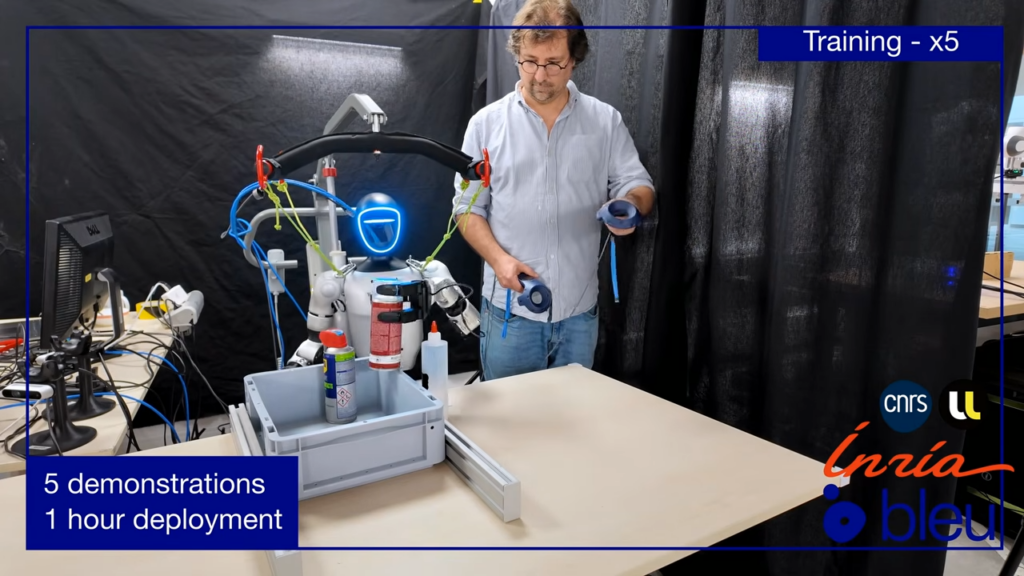
LORIA and LAAS-CNRS respectively use the Unitree G1 and Unitree H1 humanoid robots to conduct research into locomotion, learning and human-robot interaction.
These two experiences highlight several common points:
For a research team, one of the main benefits of a humanoid robot is its ability to quickly run algorithms developed in simulation.
LORIA, a computer science research laboratory, selected the Unitree G1 to work on learning algorithms and human-robot interaction projects.
LAAS-CNRS uses a Unitree H1 robot for research into walking pattern generation, reinforcement learning, machine learning and model-based control methods.
These two projects illustrate complementary approaches: the G1 is used in particular as a platform for learning and interaction, while the H1 is used to develop dynamic locomotion policies on a full-size humanoid robot.
The two laboratories did not necessarily use the same selection criteria.
LORIA selected the Unitree G1 for the quality and durability of its hardware, access to the code, its balance between performance and budget, and the existence of an active user community.
LAAS-CNRS selected the Unitree H1. Between 2024 and 2026, this platform has been a market benchmark for humanoid locomotion research. The team was looking for a powerful, full-size robot suited to the development of dynamic movements.
In both cases, the objective was to obtain a programmable robot on which researchers could deploy their own algorithms, rather than a robot limited to a series of preconfigured demonstrations.
Both LORIA and LAAS-CNRS told us that it took them just one day to get the robot up and running and become familiar with it.
The LORIA laboratory indicated that the G1 humanoid robot was easy to start and quickly operational. The researchers were therefore able to begin their developments rapidly, without spending several weeks installing and configuring the robotic platform.
LAAS-CNRS provided similar feedback. The team appreciated the fact that the Unitree H1 could walk almost immediately in teleoperation mode, although backward walking is not available in this initial configuration.
The two teams then progressed step by step: reading the documentation, checking the safety conditions, identifying the robot model and mastering the programming workflow.
Both robots allowed the researchers to test their developments more quickly against the physical constraints of a real humanoid platform.
LORIA deployed bipedal walking policies using the tools provided by Unitree. The laboratory highlighted the value of reinforcement learning in simulation to prepare tests on the physical G1 robot.
LAAS-CNRS emphasises the speed at which walking policies can be transferred to the Unitree H1. This rapid deployment facilitates iterations between simulation, programming and experimentation.
The laboratory summarises the robot’s level of performance as follows:
“Our crane is not fast enough for the walking policies we have developed for the robot.”
This statement shows that the movements being tested can exceed the capabilities of certain safety equipment commonly used during locomotion trials.
Feedback concerning the reliability of both robots has been generally positive.
For LORIA, the Unitree G1 is a reliable robot. However, the team reported some difficulties with the hands, which should be taken into account for manipulation projects or applications involving interaction with objects.
LAAS-CNRS, meanwhile, highlights the robustness of the Unitree H1. Despite executing commands described as particularly “violent”, the robot continued to operate normally.
This resistance is particularly important for locomotion research based on reinforcement learning. The resulting policies can generate fast, dynamic movements that are difficult to anticipate before they are executed on the physical robot.
The power and speed of humanoid robots require a suitable and clearly defined testing environment.
LORIA and LAAS-CNRS notably pointed out the absence of an integrated emergency stop button that would meet their safety requirements.
In all cases, it is essential to establish a clear safety framework for humanoid robot testing from the beginning of the project:
FURTHER READING
LORIA is considering expanding its setup to include several robots. This development could make it possible to create protocols involving multiple humanoid robots or to compare different behaviours across identical platforms.
LAAS-CNRS, meanwhile, plans to conduct experiments involving VLA — Vision-Language-Action models.
A vision-language-action model is a neural network that receives visual observations, such as camera images, and natural-language instructions as inputs in order to generate a wide range of physical tasks performed by a robot.
These future developments show that the G1 and H1 can support several stages of a research programme, from locomotion to broader approaches involving embodied artificial intelligence.
The experiences of LORIA and LAAS-CNRS show that the Unitree G1 and H1 humanoid robots can be quickly integrated into a research environment for a wide range of projects.
In both projects, rapid setup, straightforward programming and robustness facilitate the transition from simulation to real-world testing. However, the integration process must include the systems required to ensure the safety of researchers and equipment from the outset.
Are you developing a research project involving humanoid robotics? Generation Robots can help you select a platform suited to your work in locomotion, reinforcement learning, human-robot interaction, manipulation or embodied artificial intelligence.

Vanessa Mazzari
Head of Marketing at Generation Robots