-
 Visit our shop
-
English
Visit our shop
Scout 2.0 mobile robot
ROS2 R&D kit
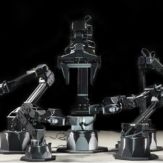
Viper 300 6 DoF robot arm
ZED 2i Polarizer 3D camera
Artemis is a NASA-led program aiming to establish a permanent human presence on the Moon.
This program also prepares future crewed missions to Mars.
The European Space Agency (ESA) contributes through multiple modules, the Orion service module, and the Argonaut lander.
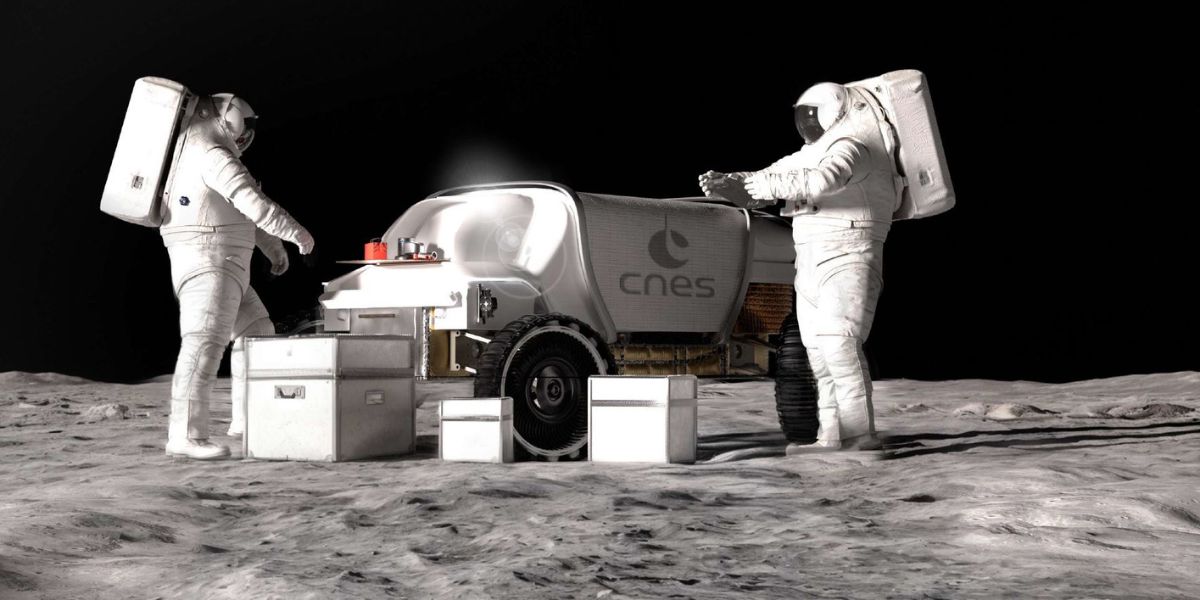
Within CNES, the SpaceShip FR project is responsible for developing a functional prototype of an astronaut assistant robot.
For the first time, Europe is establishing the industrial foundations for independent access to the Moon, with technologies designed and manufactured on its own territory.
Autonomous and reconfigurable robots will play a key role in future lunar bases.
The target robot weighs between 500 and 800 kg and is equipped with wheels, robotic arms, sensors and embedded AI. It can reach speeds of 10–15 km/h and has a range of up to 1000 km per lunar day.
The target robot weighs between 500 and 800 kg and is equipped with wheels, robotic arms, sensors and embedded AI. It can reach speeds of 10–15 km/h and has a range of up to 1000 km per lunar day.
The robots will prepare the permanent lunar base before the astronauts arrive. Once the crew is on site, these robots will assist them during their external operations, outside of the habitat.
The mobile robots will be deployed in advance and will notably be responsible for installing the base’s “heavy” infrastructure: assembling the different modules (laboratories, living quarters, kitchen, greenhouse, etc.), and installing a solar panel field to provide the base with energy.
Once the base has been set up and secured, astronauts will be able to live there for extended periods of several months.
When astronauts are on-site, the robots will perform additional missions such as:
The Moon presents unique environmental challenges:
RELATED READING
Case study: space exploration
Dynamixel-P servomotors for building Mars rovers
Developing a fleet of autonomous lunar robots is a major technological challenge, requiring collaboration across multiple disciplines and organizations.
For the first time, the ESA has established partnerships with European industrial players.
Decathlon developed an intra-vehicular suit prototype with CNES, to be tested by astronaut Sophie Adenot on the ISS.
Michelin is developing flexible airless tires to maximize traction in extreme conditions.
The mission of the SpaceShip FR department at CNES is to identify and select advanced terrestrial technical solutions which, once adapted to the constraints of the space environment, will significantly improve the efficiency of crewed missions to the Moon.
In the field of robotics for space exploration, engineers typically develop several terrestrial prototypes, each designed to validate specific aspects of the robot: the mobile platform, the sensor suite, the actuators (such as robotic arms), as well as what is referred to as the operational concept.
To validate the operational concept of the “astronaut assistant rover”, CNES is currently developing a functional prototype at 1:3 scale.
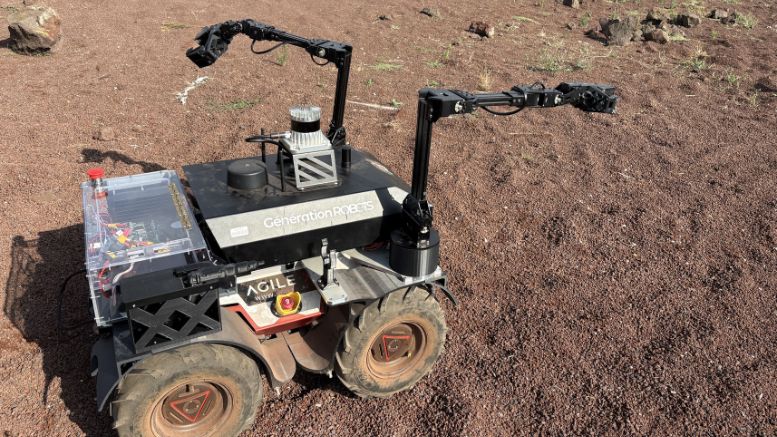
For this project, the CNES team selected the Scout 2.0 mobile robot from AgileX Robotics. Based on this platform, CNES developed and tested three additional capabilities: voice control, autonomous navigation, and two robotic manipulator arms.
When operating on the lunar surface, the spacesuit worn by astronauts makes interaction with a keyboard, touchscreen, or even a controller particularly difficult. By using voice commands, astronauts can work more efficiently while keeping their hands free.
These commands can be issued in French or English. The language model used is multilingual (even if it does not master 3 million forms of communication… unlike the famous golden robot from Star Wars!).
However, voice control for a lunar robot comes with two major constraints: limited computing resources and the absence of internet connectivity (or more precisely, the need not to rely on it).
This requires the use of a “frugal” embedded AI, designed to operate with low energy and hardware requirements.
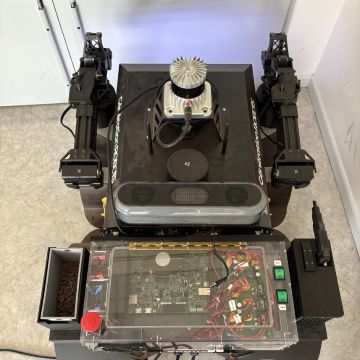
This adaptation of a standard SLM (Hammer 2.1) was carried out for CNES by Thales Service Numérique. A dedicated electronic board for this AI function was integrated into a specific enclosure mounted on the back of the rover. It is based on an AMD VEK280 kit.
To equip its demonstrator with autonomous navigation, CNES selected the ROS2 R&D Kit developed by Génération Robots. Combined with the Scout 2.0, this kit enabled the teams to rely on a mobile platform that is both robust, cost-effective, and quick to deploy.
The ROS2 R&D Kit reduces setup, development, and initial testing time by several weeks, thanks to pre-integrated hardware and software, sensors designed to work together, and an open architecture.
| Strengths of the ROS2 R&D Kit | For lunar exploration / harsh environments |
|---|---|
|
All-terrain mobility |
Testing navigation on uneven terrain |
|
ROS2 integration |
Accelerating development and testing |
|
Sensors and onboard computing |
Facilitating perception and navigation testing |
|
Modular platform |
Quickly adding and adapting new equipment |
The selected kit includes the following sensors:
Its computing architecture is based on:
On top of this coherent and immediately operational platform, CNES implemented an autonomous navigation solution using standard ROS2 packages:
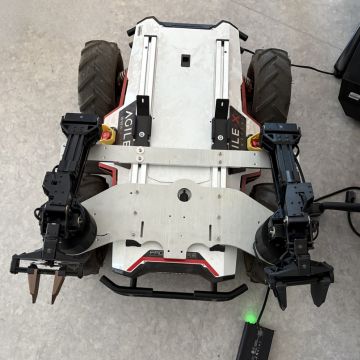
To support its demonstrator, CNES also integrated robotic arms, enabling the robot to perform manipulation and handling tasks such as sample collection and tool management for astronauts.
The ROS2 R&D Kit allows you to get started faster thanks to a ready-to-use platform, designed to simplify integration and development.
Several versions are available; tell us about your project and we will guide you toward the most suitable kit configuration. 👇
To support its demonstrator, CNES also integrated robotic arms, enabling the robot to perform manipulation and handling tasks such as sample collection and tool management for astronauts.
In the long term, these arms are intended to simulate additional logistics tasks useful for a lunar base: cleaning solar panels, installing scientific instruments, deploying wired networks, assembling structures, etc.
Selected equipment for the robotic arms:
The mechanical integration leverages the mounting rails located on the back of the Scout 2.0.
The software integration was greatly facilitated by the ROS2 platform. The required packages for controlling the arms are available and can be customized by the user.
At this stage, the arms are either teleoperated using a Logitech F710 game controller, or controlled by the rover using ROS bags. Future developments aim to enable the robot’s central unit to control the arms in real time to perform more complex tasks.
It should be noted that in space, astronaut safety is an absolute priority. The demonstrator already integrates several safety features. For example, in follow-me mode, when the astronaut approaches the robot, it moves backward to avoid contact. Similarly, the arms are configured to limit their contact force.
Lunar exploration relies on the development of innovative technologies adapted to the extreme constraints of the space environment.
Partnerships between CNES, the ESA, and European industrial players such as Génération Robots make it possible to validate the technological building blocks required to develop these robotic systems, while ensuring a high level of astronaut safety.
These collective efforts are essential to enable sustainable, efficient, and long-term lunar exploration.
Working on a similar project? We can help you structure your robotic platform. 👇

Vanessa Mazzari
CMO at Génération Robots