-
 Visit our shop
-
English
Visit our shop
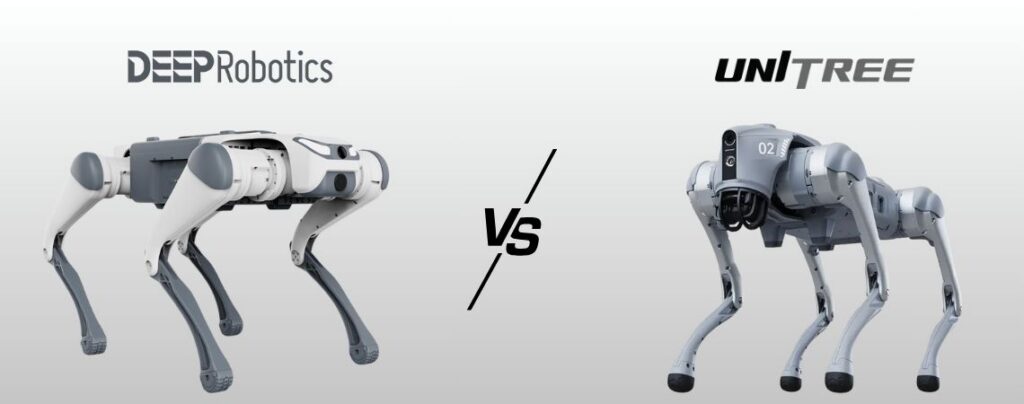
Quadruped robots are gaining ground in universities, research laboratories and R&D teams. They are no longer just impressive demonstration tools: they are becoming real working platforms for locomotion, perception, autonomous navigation and embedded AI.
Among the most closely watched models, two names often come up: the Deep Robotics Lite 3 and the Unitree Go2. Both are compact, agile and suitable for teaching as well as research, but they do not serve exactly the same purpose.
The Go2 is an excellent entry point for discovering quadruped robotics and quickly launching experiments. The Lite 3, on the other hand, is better suited to projects that require a more robust, more modular platform that can evolve beyond a simple demonstration setup.
This offer allows laboratories, engineering schools, universities and R&D teams to equip themselves with a more advanced quadruped robot, with a more accessible budget to launch or strengthen a mobile robotics project.
The choice of a quadruped robot does not depend only on price or technical specifications. It mainly depends on the intended use: discovering mobile robotics, teaching, applied research, ROS development, autonomous navigation or sensor integration.
The Go2 is a good entry point for quickly experimenting with an agile and accessible quadruped. The Lite 3, meanwhile, is better suited to projects that require a more robust, more open platform capable of evolving with the needs of the laboratory or R&D team.
The Deep Robotics Lite 3 is a compact quadruped robot designed for higher education, applied research and R&D projects. Its main advantage is that it offers a sufficiently robust and scalable base for working on advanced topics, without reaching the budgets of the heaviest industrial quadruped platforms.
Depending on the version and configuration, the Lite 3 can be used for:
In a laboratory, the Lite 3 makes it easier to move from simulation to real-world testing. Students, researchers and engineers can test their algorithms on a real mobile platform, with real-world constraints: balance, latency, sensors, calibration, changing environments and unexpected situations.
This ability to evolve with the project is what sets it apart. The Lite 3 can serve as a teaching platform, but also as a development base for more ambitious quadruped robotics projects.
The Unitree Go2 is one of the best-known quadruped robots on the market. Its success is easy to understand: it is compact, agile, attractively priced and very demonstrative.
It can perform many movements, be controlled via an app, and integrate tracking, LiDAR mapping or interaction features depending on the version. For workshops, demonstrations or first projects in quadruped robotics, it is a very interesting platform.
The Go2 is particularly well suited to:
The Go2 EDU offers more openness for development, with more advanced possibilities than the consumer versions. It is therefore a platform that should not be underestimated for teaching and certain research projects.
For teaching, both robots can be relevant, but not for the same use cases. The Go2 is very well suited to introductory courses, demonstrations and first student projects. It is visual, agile and easy to present.
The Lite 3 becomes more interesting when the robot needs to support projects over several semesters, with more software development, sensor integration or work around autonomous navigation.
For research, the choice mainly depends on the level of openness required. The Go2 EDU can be suitable for academic projects, algorithm testing or advanced demonstrations, with a fast learning curve and a more contained budget.
The Lite 3 will be more suitable if the project requires a more modular base, sensor integration, usable hardware interfaces or a more advanced development approach around ROS, SLAM, perception or autonomous navigation.
For a laboratory that wants its project to evolve over time, the Lite 3 offers a more coherent and more open base.
The Lite 3 Venture version is interesting for teams that want to go beyond the Basic version, without necessarily moving straight to a full LiDAR configuration.
It can be suitable for:
The Lite 3 LiDAR version is designed for projects that require better perception of the environment.It is particularly relevant for working on:
This is the version to choose if your project relies on 3D perception and the robot’s ability to understand its environment.
No endless forms, no waiting around. Choose the option that suits you best:
💬 A question?
🔎 Want to see it before you buy?
🎯 Ready to move forward?

Marine Senecat
Content Manager at Génération Robots