
List of products by brand Dobot
The Dobot brand offers a range of collaborative robotic arms designed to meet the needs of education, research, prototyping, and industrial automation. Known for their ease of use, compact design, and versatility, Dobot robots are used in both universities and laboratories, as well as by companies looking to automate repetitive tasks, improve the accuracy of specific operations, or quickly validate a new process.
On this page, you will find several references and product series from the brand, including the CRA series, the CRAS series, the CRAF series, the Dobot Nova 5, and the Dobot CR30H. These solutions cover a variety of uses, from light handling applications and educational demonstrations to more demanding robotic integration projects in industrial environments.
Dobot collaborative robots are particularly relevant for organizations looking for equipment that is accessible, precise, and suitable for flexible automation projects. They can be considered for applications such as pick-and-place, light assembly, automated testing, sample handling, robotics research, robotic programming education, and certain material handling operations.
Why choose a Dobot robotic arm?
Dobot robotic arms stand out for their ability to integrate into a wide range of environments. Their positioning appeals equally to teaching teams, engineers, integrators, innovation managers, and research centers looking to deploy a robotic solution within controlled timeframes.
- User-friendly programming to simplify operation and speed up deployment
- Collaborative architecture suited to shared environments and projects requiring human-machine interaction
- Compact format for easier integration into laboratories, workshops, and robotic cells
- Strong application versatility for education, research, and light to intermediate automation
- A relevant solution for prototyping, concept validation, and the gradual deployment of robotic projects
For a company, choosing a Dobot cobot often means looking for a balance between ease of integration, motion accuracy, and flexibility of use. For a university or laboratory, it is also a way to have a platform suited to hands-on training, applied research, robotic vision, or the development of technology demonstrators.
The different ranges of Dobot collaborative robots
CRA Series
The Dobot CRA series includes collaborative robotic arms designed for versatile applications. This range is intended for organizations looking for a robot capable of executing precise movements for automation, demonstration, or experimental projects.
CRA series robots may be suitable for scenarios such as:
- pick-and-place
- light assembly
- automated testing
- technical demonstrations
- collaborative robotics research
- robotic programming training
This series is a good entry point for organizations wishing to adopt a Dobot robotic arm in a professional or academic setting while maintaining a flexible approach.
CRAS Series
The CRAS series is part of the Dobot cobot range designed for collaborative applications and environments where safety, ease of integration, and compactness are important criteria. This range may appeal to industrial players looking to automate certain repetitive tasks without relying on a heavy robotic cell.
CRAS series robots may be considered for:
- automation of repetitive motions
- part handling
- semi-automated workstations
- compact robotic cells
- projects requiring human-robot collaboration
For integrators as well as technical teams, the CRAS series represents an interesting option when there is a need to combine deployment flexibility, space savings, and operational efficiency.
CRAF Series
The Dobot CRAF series targets applications requiring greater robustness and operational capability suited to more demanding industrial environments. This range fits into projects where stability, repeatability, and handling capacity are decisive factors.
Possible uses include:
- automated material handling
- industrial assembly
- production workstation automation
- component or tooling handling
- applications requiring better resistance to operational constraints
The CRAF series is intended for companies looking to move from a testing or demonstration approach to a more structured use of Dobot collaborative robotics within their organization.
Dobot Nova 5
The Dobot Nova 5 is a compact collaborative robot particularly suited to environments where space must remain limited. It may be suitable for educational, scientific, and technical applications requiring a solution that is easy to deploy, intuitive, and precise.
The Nova 5 can be used in contexts such as:
- robotics practical work
- technology demonstrations
- applied research projects
- light automation trials
- laboratory or technical showroom environments
Its compact format and positioning make it a relevant reference for organizations wishing to discover or deploy collaborative robotics without making integration more complex.
Dobot CR30H
The Dobot CR30H is intended for more demanding applications, especially when payload capacity becomes a central criterion. This model appeals to companies needing to automate more ambitious handling tasks while retaining the benefits associated with a collaborative robot.
The CR30H may be considered for:
- handling heavier loads
- palletizing
- internal logistics
- certain assembly or transfer operations
- automation of physically demanding tasks
The Dobot CR30H completes the range for users looking for a solution capable of going beyond light handling scenarios and addressing more structured industrial challenges.
Applications of Dobot robotic arms
Dobot robotic arms can be used across many sectors. Their value lies in their ability to serve as a work, experimentation, or automation platform depending on the needs of the project.
Higher education and training
In universities, engineering schools, and training centers, Dobot robots can be used for learning programming, industrial robotics, automation, mechatronics, or artificial intelligence applied to handling.
Research and laboratories
In a laboratory, a Dobot collaborative robotic arm can be integrated into projects involving vision, gripping, protocol automation, human-robot interaction, or the validation of technological demonstrators.
Industry and automation
In industry, Dobot cobots can help automate repetitive tasks such as assembly, loading and unloading, testing, part handling, or certain inspection operations.
Prototyping and innovation
Innovation and R&D teams can rely on the Dobot range to quickly test a new process, validate a robotic application, or build a proof of concept within a short timeframe.
Which Dobot robot should you choose?
The choice of model mainly depends on several criteria:
- the nature of the task to be automated
- the load to be handled
- the available space
- the required level of precision
- the context of use: education, research, demonstration, production, logistics
In general:
- the CRA series is well suited to versatile uses
- the CRAS series meets flexible collaborative integration needs
- the CRAF series targets more industrial applications
- the Nova 5 stands out for its compact format
- the CR30H is aimed at higher payload requirements
For both companies and higher education institutions, the value of the Dobot brand lies in offering solutions capable of covering several levels of maturity, from exploratory projects to more advanced automation.
What you should know about Dobot robotic arms
What is a Dobot robotic arm?
A Dobot robotic arm is an articulated robot designed to perform automated movements with precision. Depending on the range, it can be used for education, research, handling, assembly, testing, or logistics.
What is a Dobot collaborative robot used for?
A Dobot collaborative robot is used to automate repetitive or technical tasks while making integration easier in professional, academic, or experimental environments. It can help make an operation more reliable, repeat a motion consistently, and speed up certain testing or production phases.
Which profiles are Dobot robots suitable for?
Dobot cobots are suitable for laboratories, universities, research centers, integrators, engineering offices, and industrial companies that want to automate, experiment, or train on real robotic applications.
What are the main Dobot models featured on this page?
This selection includes the CRA series, the CRAS series, the CRAF series, the Dobot Nova 5, and the Dobot CR30H.
What uses can be considered with Dobot?
The most common uses include pick-and-place, light assembly, automated testing, robotics education, applied research, technological demonstrators, handling, and certain logistics operations.
FAQ about Dobot robotic arms
Why choose a Dobot collaborative robotic arm?
Choosing a Dobot robotic arm provides access to a collaborative solution suited to a wide range of needs: research, education, automation, prototyping, or industrial integration. The range appeals to organizations looking for a good balance between compactness, precision, and accessibility.
What is the difference between the CRA, CRAS, and CRAF series?
The CRA series corresponds to versatile uses, the CRAS series emphasizes flexible collaborative applications, while the CRAF series is oriented toward more industrial and robust contexts. The choice depends on the level of application requirements and the type of task to be carried out.
Is the Dobot Nova 5 suitable for education?
Yes, the Dobot Nova 5 can be suitable for educational uses, technical demonstrations, and practical work thanks to its compact format and accessible approach.
Is the Dobot CR30H suitable for material handling applications?
The Dobot CR30H may be relevant for applications where the handling of heavier loads is required, particularly in certain logistics or industrial contexts.
Are Dobot robots reserved for industry only?
No. Dobot robots are also relevant for schools, universities, laboratories, technical centers, and innovation teams wishing to develop or test robotic applications.
Why integrate Dobot into a robotics or automation project?
The Dobot brand holds an interesting position for organizations that want to deploy a robotic project progressively. Depending on the model chosen, it is possible to address needs related to discovery, education, technical validation, experimentation, or production. This versatility makes the range relevant for stakeholders who wish to move forward step by step, with equipment capable of evolving alongside the maturity level of the project.
From an operational transformation perspective, a Dobot robotic arm can help better structure certain tasks, repeat motions consistently, support a research phase, or quickly demonstrate the feasibility of automation. This ability to connect education, innovation, and practical use cases explains the growing interest in Dobot collaborative robots across many sectors.
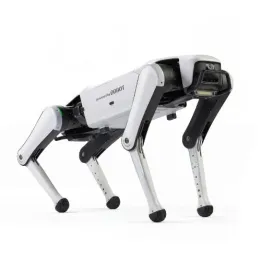
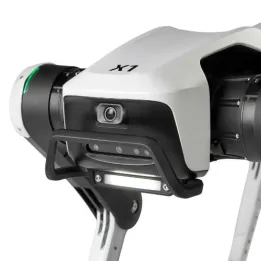
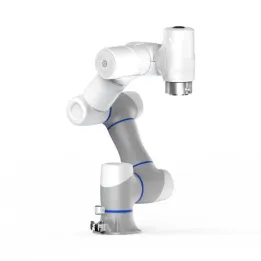
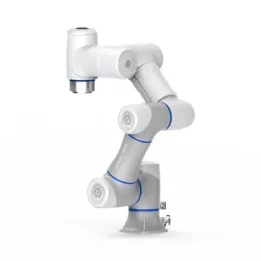
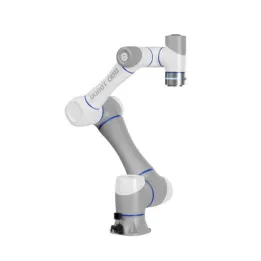
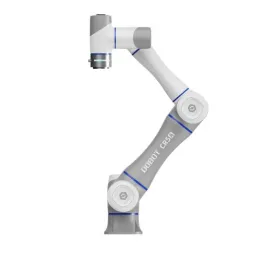
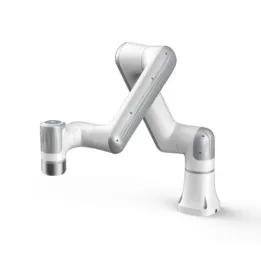
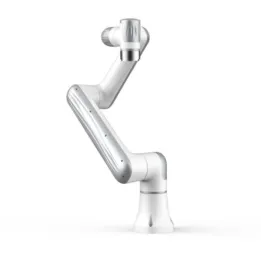
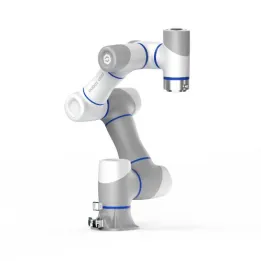
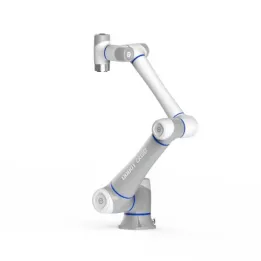
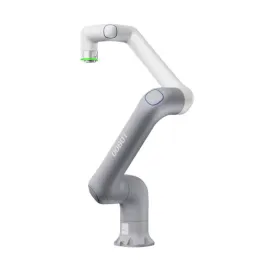
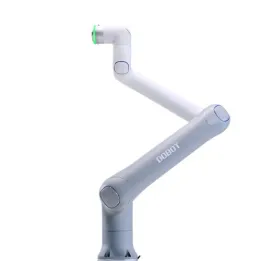
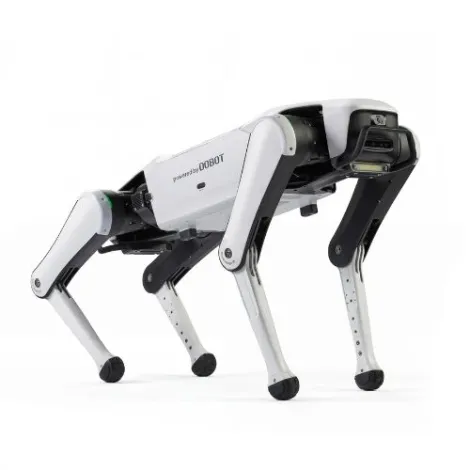
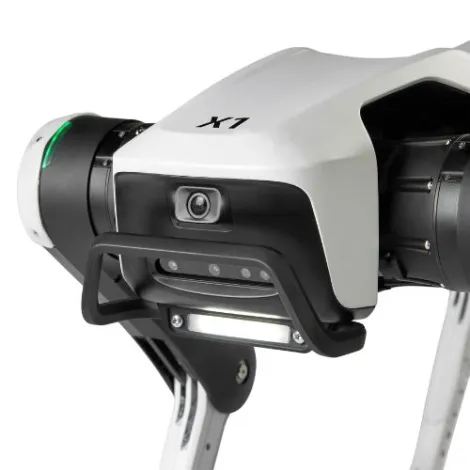
The DOBOT Rover X1 is an intelligent quadruped robot designed for tracking, light transport, mobile video capture and autonomous patrolling. It combines voice control, visual tracking, obstacle detection, front / rear cameras and multiple control modes.
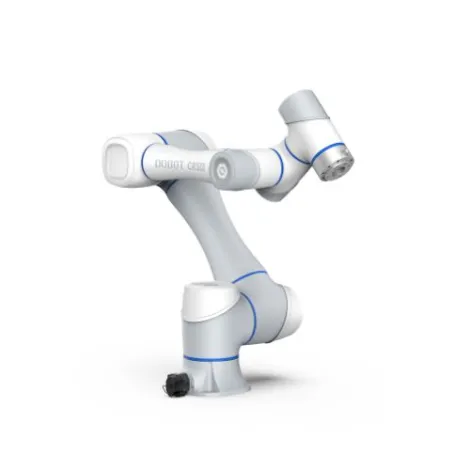
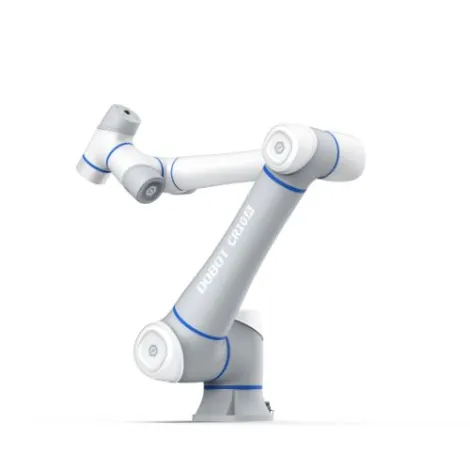
The DOBOT CRA-IP68 series includes 6-axis cobots with 5 to 20 kg payload (CR5AP, CR10AP, CR20AP) designed to automate industrial tasks in harsh environments (heavy dust, high humidity, presence of oil).
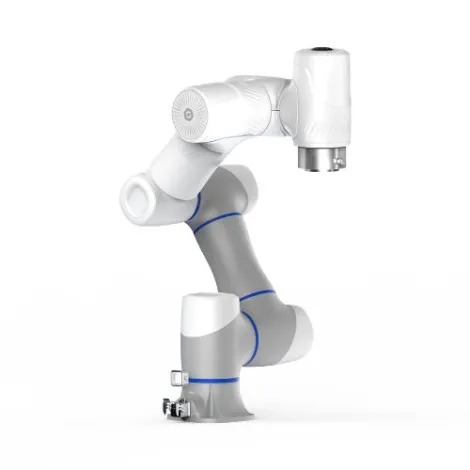
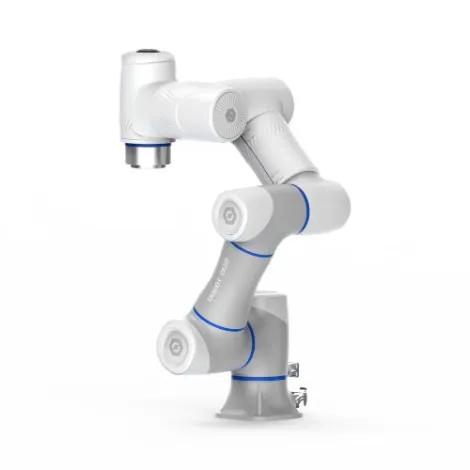
The DOBOT CRAS series includes 6-axis cobots designed to automate industrial tasks while improving safety in shared workspaces thanks to SafeSkin, a non-contact pre-detection technology that anticipates an obstacle approaching and triggers avoidance or a stop.
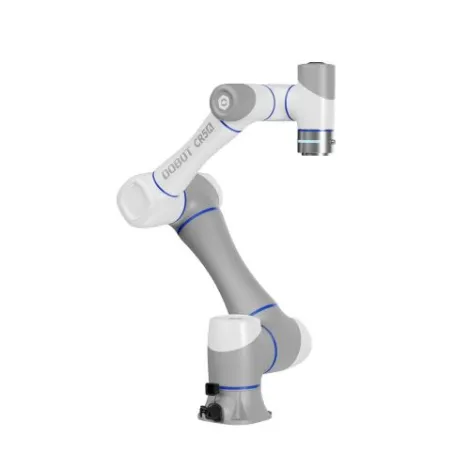
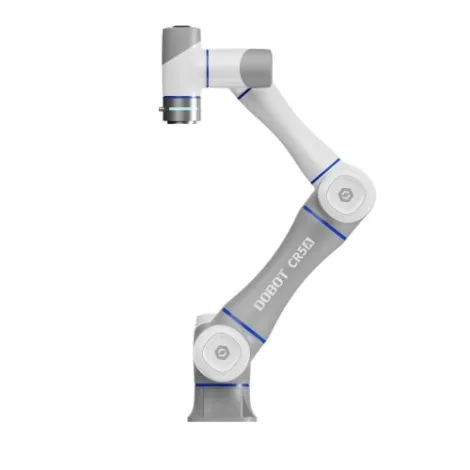
The DOBOT CRAF series includes 6-axis collaborative robots with a 5 to 20 kg payload (CR5AF, CR10AF, CR20AF), designed for applications where force control makes the difference: precision assembly, polishing / grinding, contact operations and advanced collaboration scenarios.
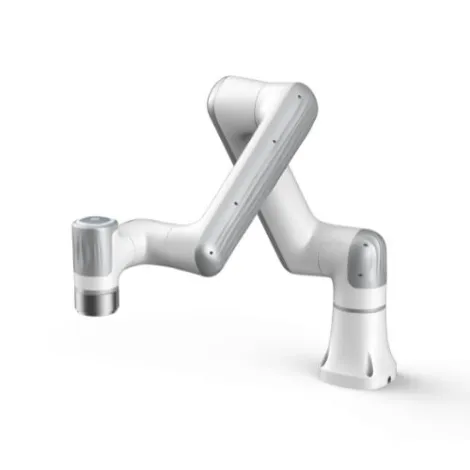
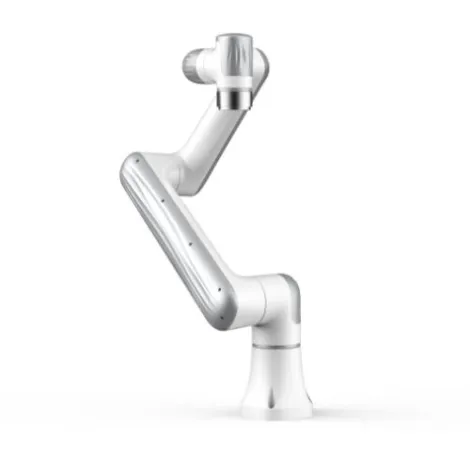
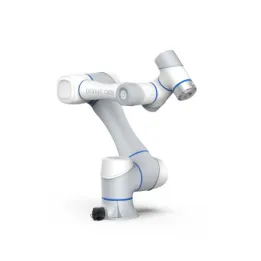
The DOBOT Nova 5 is an ultra-compact industrial robotic arm (6 axes) designed for light industry and integrations in space-constrained environments.
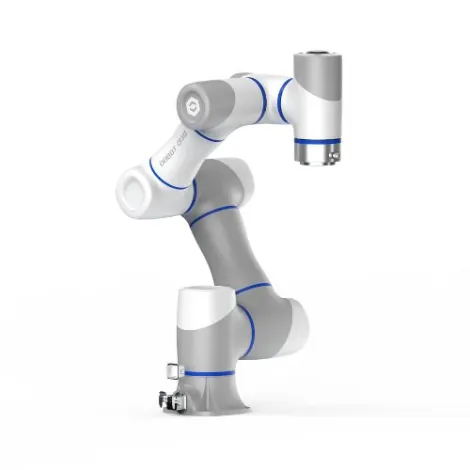
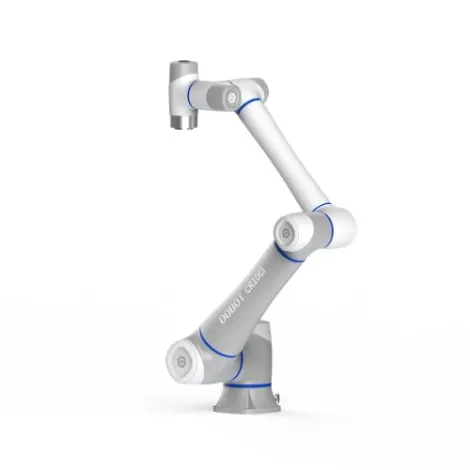
The DOBOT CRA series includes 6-axis collaborative robots with 3 to 20 kg payload, designed to quickly automate industrial tasks (material handling, assembly, CNC loading/unloading, welding, palletizing, etc.).
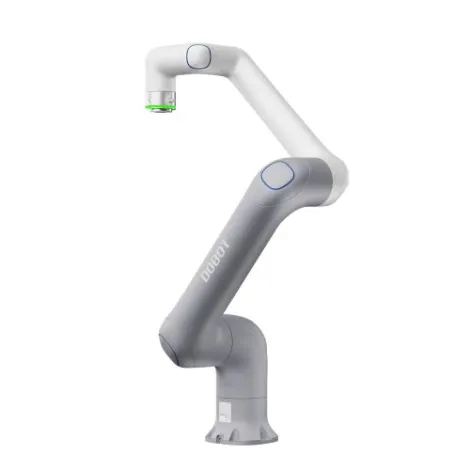
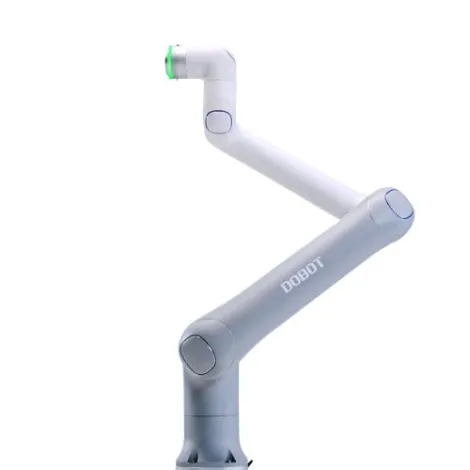
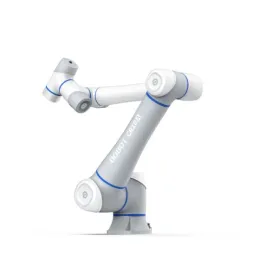
The Dobot CR 30H is a 6-axis collaborative robotic arm designed for high-payload (30 kg) and long-reach (1800 mm) use cases. It targets material handling, loading/unloading, and palletizing tasks.