Get a quote in only 3 steps!
1. Add the items you are interested in to your cart
2.Go to your cart
3.Click on GENERATE A QUOTE
Tous vos devis sont accessibles à partir de votre compte client.
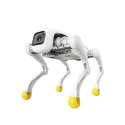
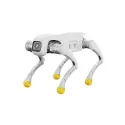
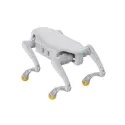
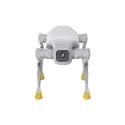
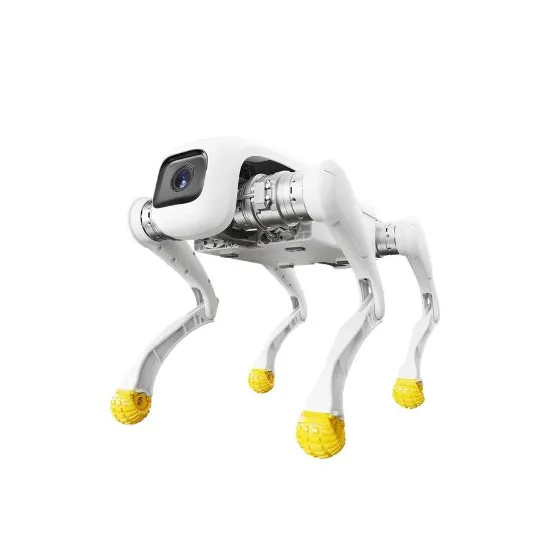
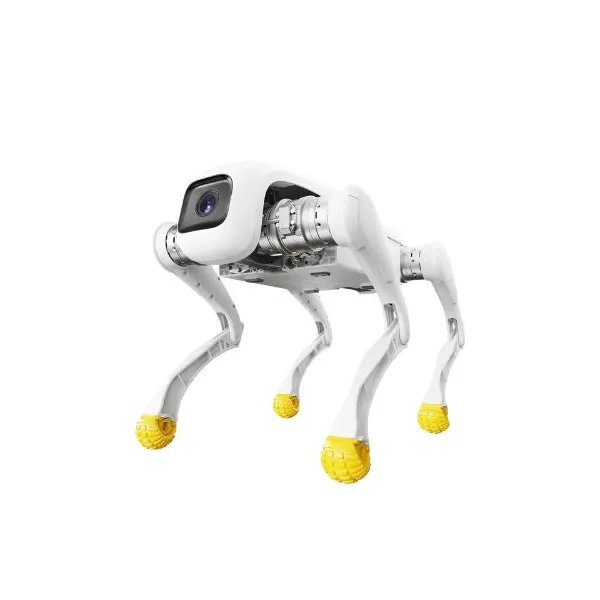
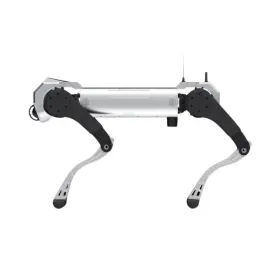
The AgiBot D1 Pro quadruped robot is a four-legged mobile platform designed for dynamic locomotion, complex terrain exploration, robotic demonstrations, and certain research or lightweight mobile robotics projects.
The AgiBot D1 Pro quadruped robot is designed for teams looking for an agile mobile platform for locomotion on varied terrain, technology demonstrations, experimentation around gait control, light inspection, or mobile robotics research.
Higher education and research: the D1 Pro can be used by universities, engineering schools, and laboratories as a mobile quadruped platform for working on locomotion, perception-guided navigation, terrain adaptation, or multi-sensor fusion. Its more accessible price positioning compared with some industrial platforms makes it an interesting option for exploratory, educational, or technology validation projects.
Public demonstrations and technology showcases: thanks to its agility, dynamic movements, and strong visual impact, the AgiBot D1 Pro is well suited to technology showcases, STEM events, trade shows, or robotic demonstrations in public environments. It is particularly suitable for scenarios where mobility, reliability, and demonstration value matter more than carrying heavy payloads.
Light inspection and security pilots: its ability to climb stairs, handle slopes, and move over uneven terrain makes it possible to consider light inspection pilots on certain sites, campuses, or technical facilities. When paired with additional sensors, it can also serve as a basis for demonstrators focused on mapping, navigation, or mobile monitoring.
The AgiBot D1 Pro quadruped robot is a relevant platform for mobile demonstrators, exploratory projects, and use cases where agility, speed, and mobility on complex terrain are priorities.
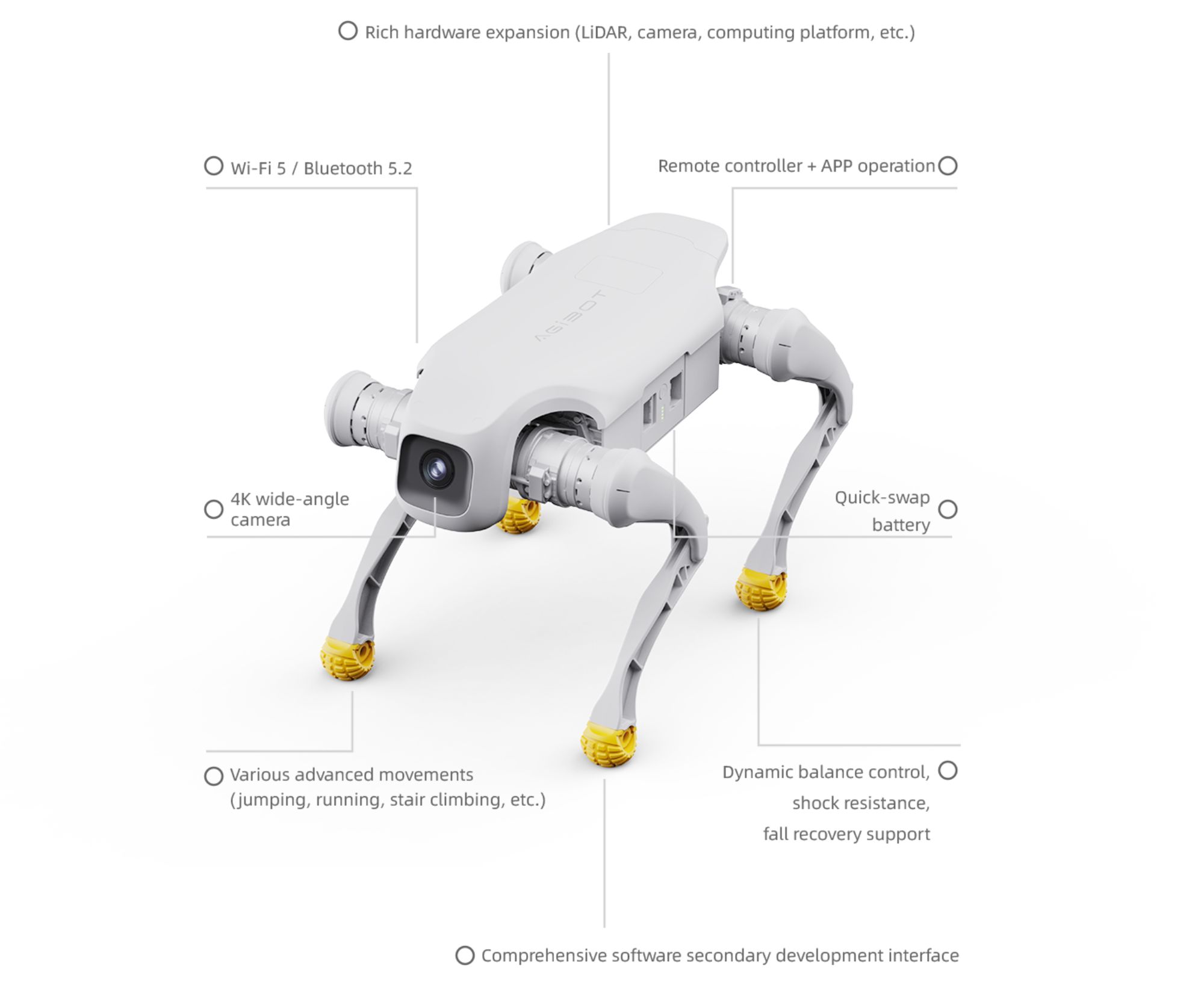
The AgiBot D1 Pro highlights locomotion based on reinforcement learning, with self-balancing, disturbance resistance, and strong obstacle-crossing capabilities. It is compatible with various modules such as positioning systems, LiDAR, depth cameras, RTK modules, 4G/5G modules, and image transmission systems. The platform also comes with a URDF model for simulation and testing in Isaac Sim and MuJoCo.
For a quotation request regarding the AgiBot D1 Pro quadruped robot, please specify your estimated budget, your project timeline, your delivery address, your use case (demonstration, research, mobility, inspection, events, etc.), and the expected functions: speed, obstacle crossing, battery life, video transmission, additional modules, payload, indoor/outdoor environment, and desired level of support.
| Standing dimensions | Approx. 635 × 360 × 420 mm |
| Folded dimensions | Approx. 675 × 435 × 145 mm |
| Weight | 15.5 kg (battery included) |
| Operating temperature | 0 °C to 40 °C |
| Charging time | ≤ 2 h |
| Battery life | 1 to 2 h |
| Range | Up to 6 km |
| Onboard computing | High-performance 8-core CPU |
| Max. power | 3500 W |
| Max. speed | 3.5 m/s |
| Max. payload | ≈ 8 kg |
| Max. step height | 16 cm |
| Max. slope | 40° |
| Jump height | 35 cm |
| Actuator type | High power-density motion unit |
| Max. joint torque | 48 N·m |
| Joint motors | 12 precision aluminum-alloy motors |
| Body joint range | -28° to 28° |
| Thigh joint range | -170° to 66° |
| Lower leg joint range | 35° to 156° |
| Camera field of view | DFOV 122°, HFOV 111°, VFOV 70° |
| IMU | Yes, standard |
| Standard actions | Stand, lie down, damping mode, pitch adjustment, height adjustment, horizontal rotation |
| Special actions | Forward jump, vertical jump, bipedal stance, backflip, salute, etc. |
| Real-time video transmission | Supported |
| Battery | 5 Ah nominal (4.6 Ah), 43.2 V voltage |
What is the AgiBot D1 Pro quadruped robot?
The AgiBot D1 Pro is a quadruped robot designed for demonstrations, certain higher-education projects, applied research, and light exploration or inspection scenarios. It stands out in particular for its dynamic locomotion based on reinforcement learning, designed to improve stability, agility, and terrain adaptation.
What are the mobility capabilities of the D1 Pro?
The D1 Pro is presented with a high speed for its category, stair-climbing, jumping, and slope-traversing capabilities. Depending on the configuration and use scenario, it can suit environments with uneven floors, small steps, and moderate obstacles. For a real project, it is still advisable to validate the expected performance according to the actual terrain, payload, and operating conditions.
Why can the D1 Pro be interesting for a lab, a school, or a demonstrator?
The AgiBot D1 Pro provides access to an agile quadruped platform without moving into the budget range of a more expensive industrial robot. It can therefore be an interesting basis for projects around locomotion, mobile perception, navigation over varied terrain, or embodied robotics in an educational, exploratory, or event context.
Is the robot suitable for higher education and research?
Yes, the D1 Pro can suit universities, engineering schools, and laboratories that want to work on quadruped mobility, terrain adaptation, perception-guided navigation, or the fusion of data from multiple sensors. However, it is important to verify that the Pro version matches the level of openness and integration expected for your project.
Is the D1 Pro relevant for public demonstrations or events?
Yes, its agility, speed, and dynamic movements make it an interesting platform for technology demonstrations, STEM events, trade shows, or innovation-oriented activations. It is particularly suited to scenarios where visual impact, mobility, and reliability matter more than carrying heavy payloads.
Can it be used for light inspection or security applications?
The D1 Pro can suit light inspection pilots or demonstrators on sites with steps, slopes, or uneven ground, for example on a campus, in a technical building, or on a demo site. For more intensive duty cycles, harsher environmental constraints, or a greater need for protection, it may be relevant to consider a more robust version or another quadruped platform.